Against the Wheels of Fate: Pasternak’s Doctor Zhivago
War is cyclical and self-nourishing. The bloodied trail of intentional and unintentional consequences lays the path for the next to follow. Generation after generation unavoidably faces its own set of vicious conflicts, offering the weary souls who survive them endless material for doleful novels, elegiac music, and other forms of artistic expression. As Hungarian writer and Nobel Prize winner László Krasznahorkai writes in his ominous novel War & War: “THE SPIRIT OF HUMANITY IS THE SPIRIT OF WAR.” Even for the most optimistic soul, it is difficult to trace the history of humanity without concluding that this recurring pattern of self-destruction is embedded in who we are as a species. Yet despite the perennial presence of such terror, art—which embodies our humanity—stubbornly persists as an inextinguishable fire, casting a desperate light into the bleak abyss of our grim daily realities.
One such example of this resilient light amid surrounding darkness is the Russian historical epic Doctor Zhivago, in which Boris Pasternak affirms the notion that art “always meditates on death and thus always creates life.” Writing within the vise grip of Soviet censorship, Pasternak himself epitomized both the flaws and virtues of his tragic hero in an enduring work that ignited international controversy.
Truth Cannot Be Silenced
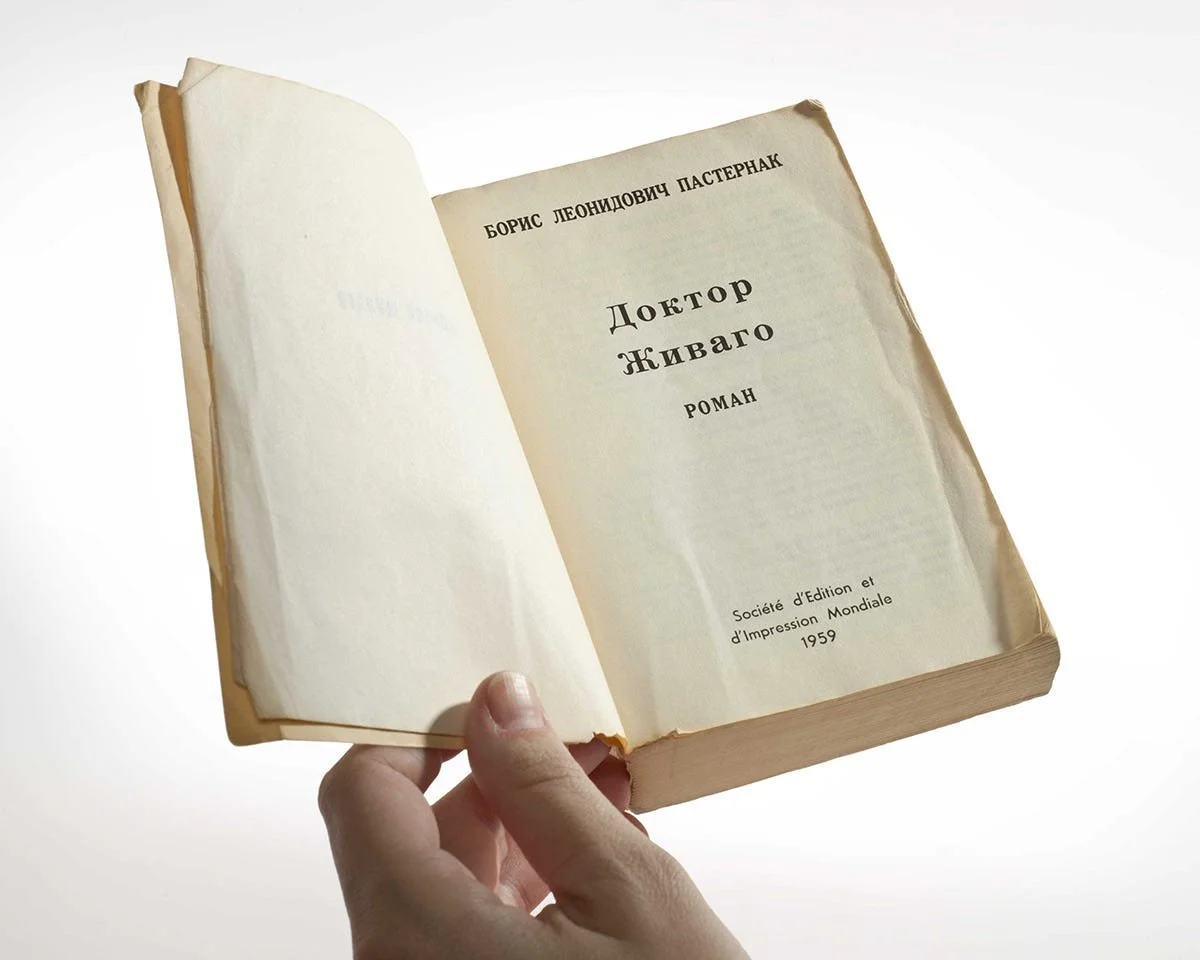
Copy of the original Russian-language edition of Doctor Zhivago, covertly published by the CIA
Doctor Zhivago was a hit internationally—but not by accident. Popularized in a Hollywood film adaptation and proliferated by the C.I.A. through covert operations, Boris Pasternak’s historical epic captures one of the darkest, barbarous, and morally depraved periods of Russian history. Pasternak began writing the novel in 1945, around the close of World War II, but didn’t finish his masterpiece until 1955, before having it smuggled to Italy for publication. Pasternak originally submitted it to the literary journal Novy Mir (Новый Мир) in 1956, but it was swiftly rejected—for reasons obvious to those who have read it. Besides the ambiguous and largely critical depictions of Bolshevism and the Red Terror perpetrated by the Red Army during the Russian Civil War, one of the central conflicts of the novel is the erasure of individualism carried out by socialism. In short, Doctor Zhivago was justifiably labeled anti-Soviet for its endorsement of individual identity and freedom of opinion—a sharp contrast to the Socialist Realism being written at the time. After facing rejection from Soviet censors, Pasternak gambled with his work (and possibly his life) by passing the manuscript off to an Italian publisher; the rest is history. The C.I.A. quickly seized the opportunity to propagate what they saw as a tendentious novel expressing the evils and contradictions of the Soviet Union. The 1965 American film adaptation starring Omar Sharif only further canonized the novel.
When Ideology Consumes
In the opening chapters of the novel, Pasternak points to one of the core ideas of his work through a pithy rejoinder, cautioning against the subjugation of individuality and the manipulation of truth: “Only individuals seek the truth, and they shun those whose sole concern is not the truth.” For practically the entirety of its existence, the Soviet Union was fundamentally rooted in ideology—not reality. Bolshevism rationally and effectively articulated the abuses of imperialism and capitalism, but failed to substantiate its idealistic solutions with tangible realities. Its devoutly professed utopian society never came to fruition, and even when its castle in the sky was swept away by the gusts of impracticality, the government stubbornly persisted in its dismissal of truth. It persisted in an Orwellian denial of its own eyes, fearing that admission would lead to utter collapse—which did eventually occur in 1991, when empty promises could no longer feed a malnourished population. This feeble attempt to sweep ugly truths behind a curtain of collectivism and propaganda is made all the more evident in the novel’s final chapter:
“I think that collectivization was an erroneous and unsuccessful measure and it was impossible to admit the error. To conceal the failure people had to be cured, by every means of terrorism, of the habit of thinking and judging for themselves, and forced to see what didn’t exist, to assert the very opposite of what their eyes told them. This accounts for the unexampled cruelty of the Yezhov period…”
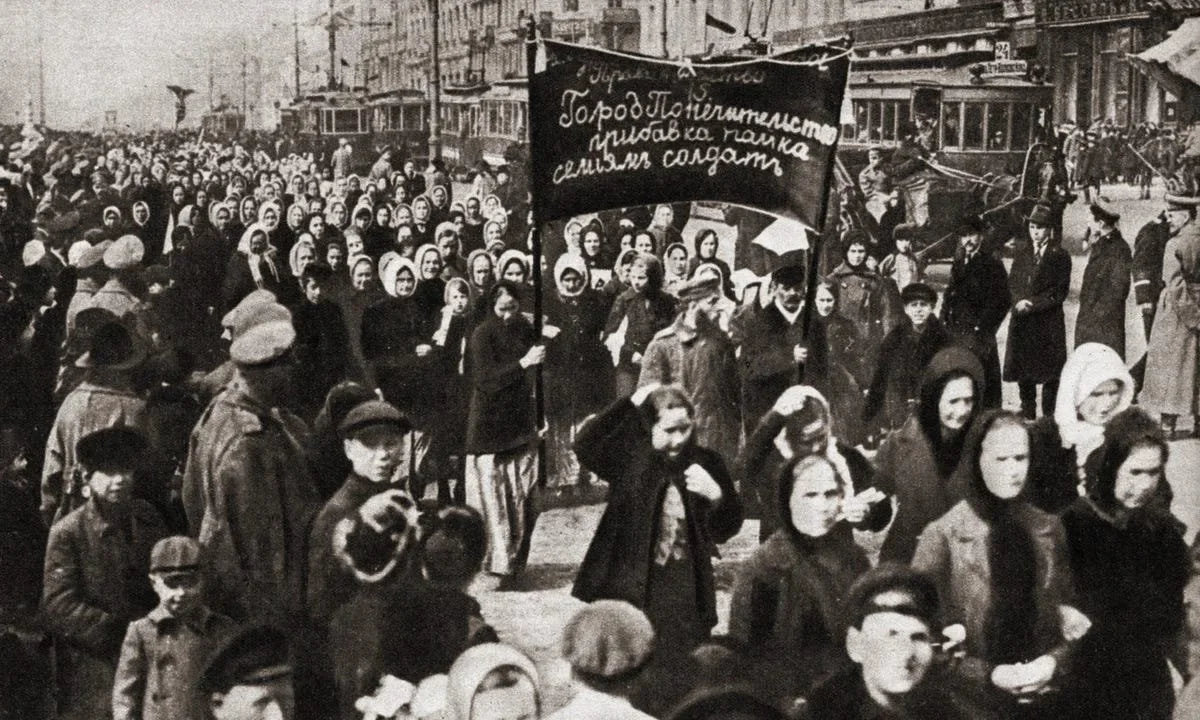
Women’s Day demonstration in Petrograd on March 8th, 1917
We must not forget that the Soviet Union was born from a tempestuous sea of converging grievances. Workers, women, peasants, and disillusioned soldiers merged their interests along with the professional revolutionaries who led the charge throughout the year of 1917. Revolution became inevitable, as one of the Bolsheviks in Doctor Zhivago expresses clearly:
“Gluttons and parasites sat on the backs of the starving workers and drove them to death, and you imagine things could stay like that? Not to mention all the other forms of outrage and tyranny. Don’t you understand the rightness of the people’s anger, of their desire for justice, for truth? Or do you think a radical change was possible through the Duma, by parliamentary methods, and that we can do without dictatorship?”
One of the naive counterfactuals presented regarding the Russian Revolution is that the Russian people would have been better off under the Russian Provisional Government or the continued rule of the Romanovs. Counterfactuals are always impossible to disprove with certainty, but this suggestion neglects the decades of fomenting resentment toward the ruling elites and the exploitation inflicted on each oppressed class. Nicholas II’s October Manifesto, which promised reform, turned out to be an empty, worthless document, along with the State Duma, which gave the masses power only in theory. Before the Bolsheviks began their genocidal war with the peasantry, grain-requisitioning policies—known as продразвёрстка—had already been enacted by the Tsarist regime in the fall of 1916. It was the Tsardom’s failings and antagonistic policies, paired with a devastating world war, that opened the floodgates to a sea of socialism fed by individual raging rivers—or, as Pasternak calls them, “private, individual revolutions.”
Desperation made exploitation, collectivization, and compliance among the masses far easier. It was the right time, the right place, and the right ideology for the suffering classes. Following the revolution, there was hope for change and a willingness to toil for a time, as long as the light of socialism flashed ahead. The hero of Pasternak’s novel, Yuri Zhivago, adopts this hopeful attitude, clinging to comforting illusions. But after returning from the war front to a disheveled, lawless Moscow, his thoughts probe the responsibility of the individual and the incongruence between Bolshevik idealism and his experience of reality:
“But where is reality in Russia today? As İ see it, reality has been so terrorized that it is biding. I want to believe that the peasants are better off and flourshing, If it is an illusion, what am I to do? What am I to live by; whom am I to believe? And I have to go on living, I've got a family.”
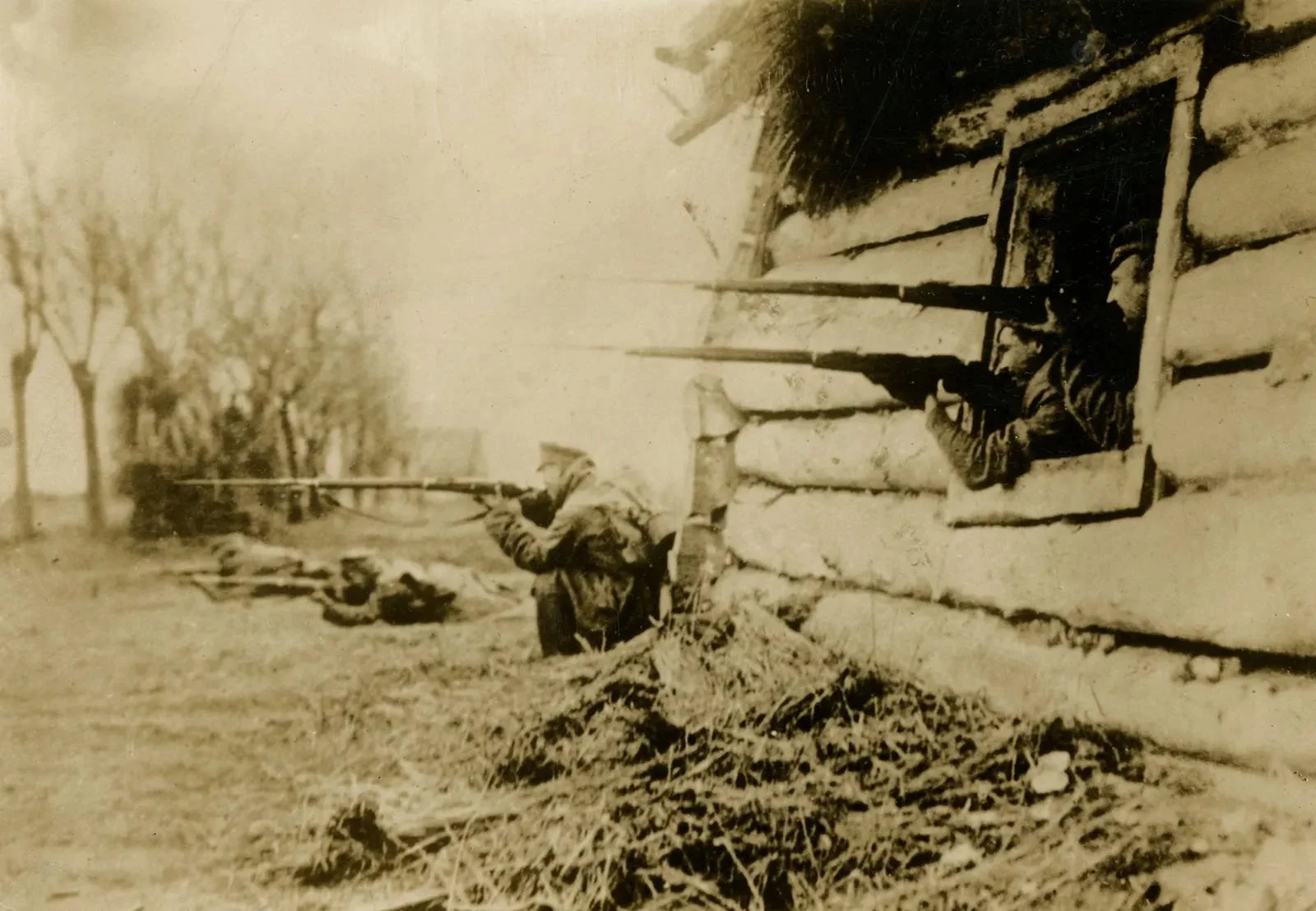
Soldiers firing from a home in a Russian village
These painful sentiments capture not just Yuri’s anguish, but the feeling of helplessness we all experience in the face of senseless destruction. Innocent bystanders are thrust about in the chaos of war and revolution, struggling merely to keep themselves and their families alive, let alone stand up against the Goliath of brutish power. Through Pavel Antipov/Strelnikov and several other characters, Pasternak depicts how revolutionary war strips individuals of their names, families, and entire identities. They become utterly subsumed within a collectivized ideology. This flattening of identity reveals how the weakness of individuality and independent thought leaves the mind exposed to all manner of contradictory beliefs, poisonous prejudices, and irrational actions. Despite his extremist turn, Yuri retains hope for Pavel Antipov, even recognizing an enduring spark of identity within him:
“It’s a good thing when a man is different from your image of him. It shows he isn’t a type. If he were, it would be the end of him as a man. But if you can’t place him in a category, it means that at least a part of him is what a human being ought to be. He has risen above himself, he has a grain of immortality.”
In the end, what is a man to do? What is the responsibility of the individual? What impact can he or she truly make against the unstoppable wheels of fate? Pasternak’s novel seems to suggest that the bare minimum begins with maintaining one’s moral duty and dignity. We can certainly stand opposed to evil on a personal level, look out for one another, and attempt to preserve our own humanity. Not losing our moral foundations and joining in the humanitarian calamity is the least one can do, and it certainly creates an impact.
Pasternak can’t help but pour impressions of his own strife and conflicted resistance, while also weaving in glaring Shakespearean themes. Throughout the work, Yuri mirrors the same moral trials as Hamlet, who adamantly refuses to be corrupted by the corrupt society he finds himself in. This symbolism is driven home in the poems that conclude the novel.
Art as Immortal Salvation
Although the novel is steeped in the contentious political affairs of his native country, Pasternak’s most significant ideas aren’t confined to Russia. Foreshadowed by the ideological influence of his Uncle Nikolai, Yuri’s transformation culminates in a transcendental faith in art’s capacity to express truth and safeguard humanity.
In his adolescence, Yuri, along with other rationalistic and Marxist-inspired youths, dismisses the utility of the humanities—namely, the Symbolist movement and writers like Alexander Blok. He largely devalues art and, upon graduation, chooses to study medicine, viewing art as impractical:
“He thought that art was no more a vocation than innate cheerfulness or melancholy was a profession. He was interested in physics and natural science, and believed that a man should do something socially useful in his practical life. He settled on medicine.”
Many of us don’t recognize the necessity of literature, music, and painting until we fall in love for the first time, or until we stand at a loved one’s grave and find solace in a sorrowful poem. Yuri experiences the same awakening after enduring the vileness of war, navigating his romantic affair with Lara Antipova, and confronting his conflicted feelings about returning to his family. Earlier in the work, his uncle argues with a friend named Vyvolochnov about Symbolism, suggesting that romantic art possesses a religious, salvatory dimension:
“Now what is history? It is the centuries of systematic explorations of the riddle of death, with a view to overcoming death. That’s why people discover mathematical infinity and electromagnetic waves, that’s why they write symphonies. Now, you can’t advance in this direction without a certain faith. You can’t make such discoveries without spiritual equipment. And the basic elements of this equipment are in the Gospels.”
There remains something quasi-religious about the way that art connects with us. It expresses the inexpressible, assigns words to what cannot possibly be said, performs a melody that embodies an emotion. It reaches into our souls and translates human experience into something tangible, immortalizing it for current and future generations. Pasternak captures this in a powerful speech by Yuri that rebukes the reshaping of life through a materialistic, rationalistic lens:
“Reshaping life! People who can say that have never understood a thing about life-they have never felt its breath, its heartbeat-however much they have seen or done. They look on it as a lump of raw material that needs to be processed by them, to be ennobled by their touch. But life is never a material, a substance to be molded. If you want to know, life is the principle of self-renewal, it is constantly renewing and remaking and changing and transfiguring itself, it is infinitely beyond your or my obtuse theories about it.”
Perhaps most importantly, art preserves the lives of victims and the painful truths of history. Every war provokes innumerable artistic pleas of resistance and works of remembrance. Pasternak’s Doctor Zhivago doesn’t simply recite the story of a blood-soaked period in Russia’s past, but continues to demonstrate to us the immortal light and goodness that exists in individuals. In the face of wars today and tomorrow, we must lean on freedom of expression, freedom of independent thought, and a resilient commitment to individual moral duty.
