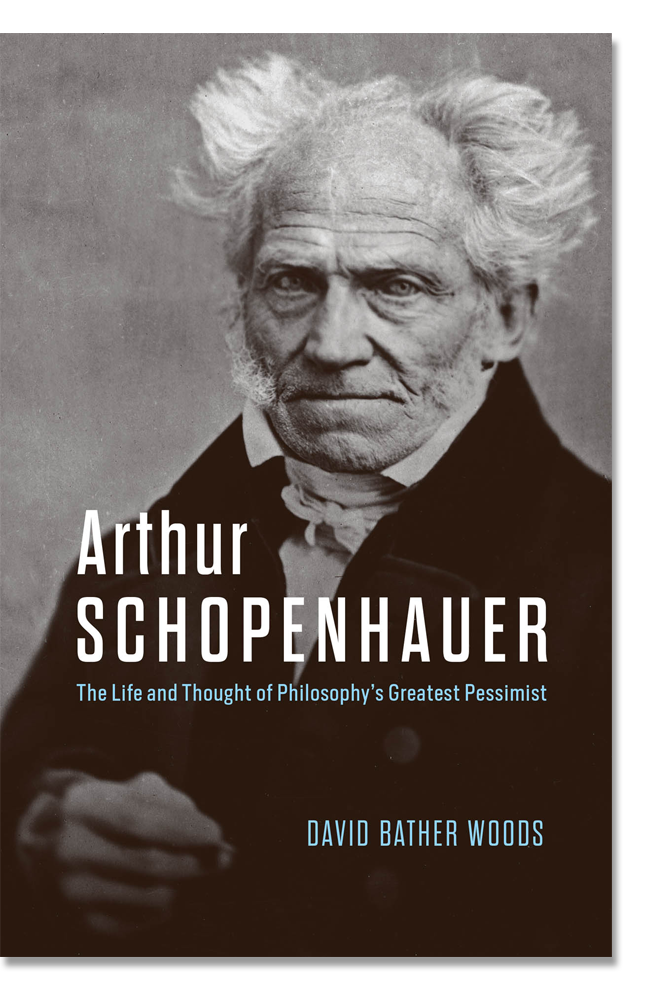
Reviewed:
Arthur Schopenhauer: The Life and Thought of Philosophy’s Greatest Pessimist
by David Bather Woods
Chicago University Press, 296 pp., $30.00 (Hardcover)
Publication Date: 11/18/25
Philosophers are rarely regarded as desirable house guests or sought-after company. Few find overt erudition, naval-gazing, and ceaseless pontificating on death attractive qualities in someone they would call a companion. Perhaps the quintessential example of such an unpleasant, yet world-class thinker is the German philosopher Arthur Schopenhauer. Branded as “The Great Pessimist,” Schopenhauer’s unsettling, bleak ideas came packaged with a haggard physiognomy and an infamously anti-social temperament. But beyond his bitter reputation lies an immense, enduring legacy of theories, concepts, and universal advice that influenced literary giants such as Leo Tolstoy and Samuel Beckett, the iconic composer Richard Wagner, and philosophers like Friedrich Nietzsche.
Fighting for attention within a crowded Germanic tradition full of heavyweight thinkers, Schopenhauer has long been overdue for a biography that revisits the complexities of his life, as well as the enduring relevance of his often misunderstood ideas. In just under 300 pages, David Bather Woods delivers precisely that in his latest book, Arthur Schopenhauer: The Life and Thought of Philosophy’s Greatest Pessimist. In contrast to the pessimist’s cantankerous, nihilistic reputation, Woods presents Schopenhauer in a new light, exploring his compassion, clairvoyance, and surprising sensitivity. Adequately paced and brimming with insightful, lucid explanations, his biography offers a valuable, entertaining introduction for curious readers.
Woods opens with a thoughtful introduction, making light of why Schopenhauer’s epigrams often provoke laughter. In fact, much of the pessimist’s essays are filled with sardonic quotes, such as “Life swings like a pendulum backward and forward between pain and boredom,” that provoke nervous laughter at the audacity and accuracy of the statement. Wood assures readers that despite Schopenhauer’s unsettling comedic comments, we are sure to find a recurring theme of love—in various forms—within his writings.
Arthur Schopenhauer was raised in a wealthy, cultured family led by polyglot, highly educated parents. Following in the mercantile footsteps of his father, Schopenhauer’s direction and perspective were irrevocably altered by his father’s sudden suicide. Woods uses this event as a vantage point for exploring several of the German’s positions regarding suicide, sympathy, and punishment. This tragedy dissolved the burden of his father’s vocational demands, granting Schopenhauer the freedom to pursue academic study. His exceptionally educated mother also took the opportunity to pivot and launch a successful literary career—an early example of the many complex relationships Schopenhauer would have with women throughout his life.
Woods’ biography runs the gamut—from Schopenhauer’s disputed views on homosexuality, to his degrading essay on women, to his wacky proposal for regulating polyamory—astutely exposing the contradictions and contentious positions that permeated his worldview. This includes his reluctant reverence for the precocious sculptor Elisabet Ney, whose skilled bust of Schopenhauer astonished him and prompted a backhanded compliment: “It seems to me more and more unbelievable that you are a woman every day.” It’s hard to believe that the same man who compassionately condemned the slave trade and cruel American prison systems could simultaneously hold misogynistic views toward women, in spite of having an esteemed mother; but much of Schopenhauer’s compassion was grounded in his metaphysics rather than in ethical reasoning.
Schopenhauer unabashedly held contempt for society, making him an unlikable and complicated candidate for sympathy, but it was this innate disposition toward solitude that led to his most universally beneficial principle: a staunch advocacy for thinking for oneself—or Selbstdenken in German. He believed that true knowledge lies not in books or in the passive consumption of others’ ideas, but in personal experience followed by cognitive digestion and contemplation. As Woods explains: “Thinking for yourself produces the best-quality knowledge, Schopenhauer argued, because true wisdom is not simply a matter of possessing all the correct facts.”
Woods’ biography is a delightful read that peels back the layers of the German philosopher’s tangled life, revealing his humanity with each anecdote and intellectual digression. He anchors each chapter with a particular area of focus before effortlessly floating across timelines, momentous relationships, and chance encounters that helped shape Schopenhauer’s influential theories. Condensed to an approachable length, his work serves both to entice new learners and to inform loyal Schopenhauerians of the relevant, enduring ideas of The Great Pessimist.
