Reviewed:
by Antonio Moresco,
Translated by Max Lawton
Deep Vellum, 651 pp., $24.95 (paperback)
Publication Date: 3/24/26
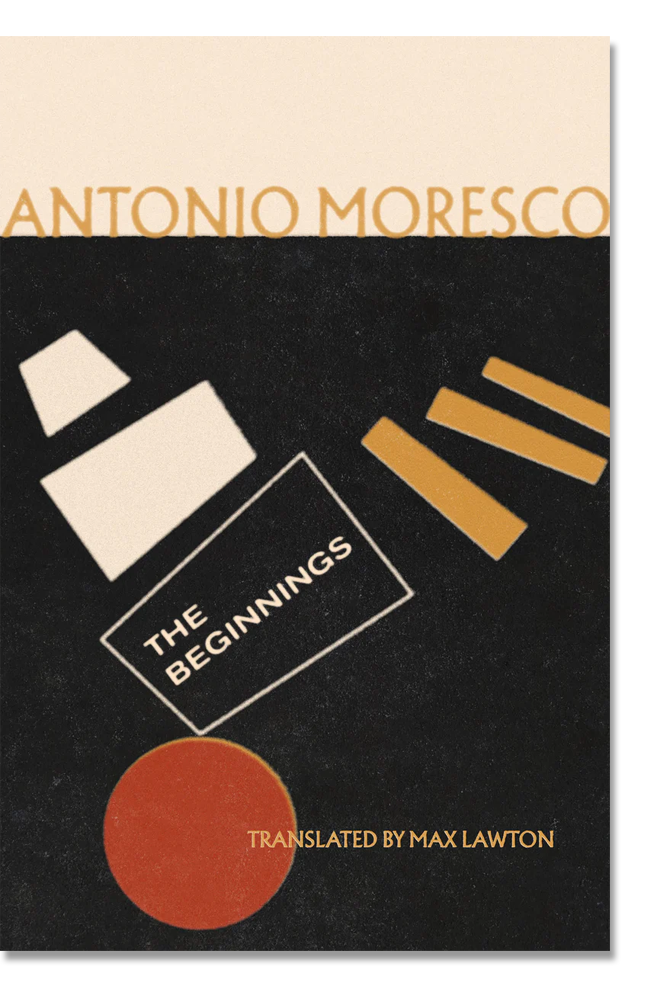
Arguably, the chief objective of a fictional narrative is immersion, with the author acting more like a scenographer or a sculptor, chisel in hand, slowly chipping away at a block of text to create a seductive atmosphere in which onlookers lose themselves—Antonio Moresco’s The Beginnings is the set piece of such a sculpture. Appearing for the first time in English, The Beginnings is the inaugural volume of his expansive trilogy Games of Eternity (Giochi dell’eternità). Here, Moresco presents a bildungsroman framed within a triptych of metaphysics, vulgarity, and baffling eccentrics, reminiscent of Kafka’s inscrutable machinations. The novel unfolds through a nameless, unreflective narrator who relays raw descriptions of each preposterous encounter as he passes through three phases of his life: studies at a seminary, underground political activism, and an ambition to become a published writer. Shifting beneath the reader’s feet, The Beginnings is a vertiginous, feverishly compelling work, offering a feast of surreal imagery and inventive language to those who approach it patiently.
Part One, titled “The Silence Scene,” opens with our hero’s time in a seminary, where he meets a older, sinister prefect referred to as The Cat, as he and the others are guided through their training by the father superior. Loaded with rich, farcical visuals and isolating language, the narration unspools like a silent film; but rather than a flickering monochromatic reel, readers are presented with hallucinogenic technicolor. This dream-like sensation becomes even more apparent when he is transported by a leather-suited motorcyclist to a nearby villa Ducale, where he is greeted by a strabismic woman named The Peach and a band of zany characters, each identified by a sobriquet: Turquoise, Uncle, Albino, Lenin, and so on. In the midst of his wanderings, grandiose scenes erupt: boisterous cars file into the villa, “spinning around their own axes,” and cacophonous chatter gives way to the dispersal of record players and lengthy electrical cords unfurling across the courtyard. Later, a monolithic trash heap is set ablaze during Turquoise’s wedding, unexpectedly sending her into labor as the infernal spectacle accelerates her fetus’s maturation. Soon after, the narrator returns to the seminary in time for the celebration of Passio Domini, during which Moresco first teases the concept of uncreating:
“…in this human time that shrinks and expands, everything seems easy and difficult in equal measure and to drag a cross is as difficult as to remove a little ball of earwax from one's ear ... Oh, Father, our creation is slowly uncreating us!"
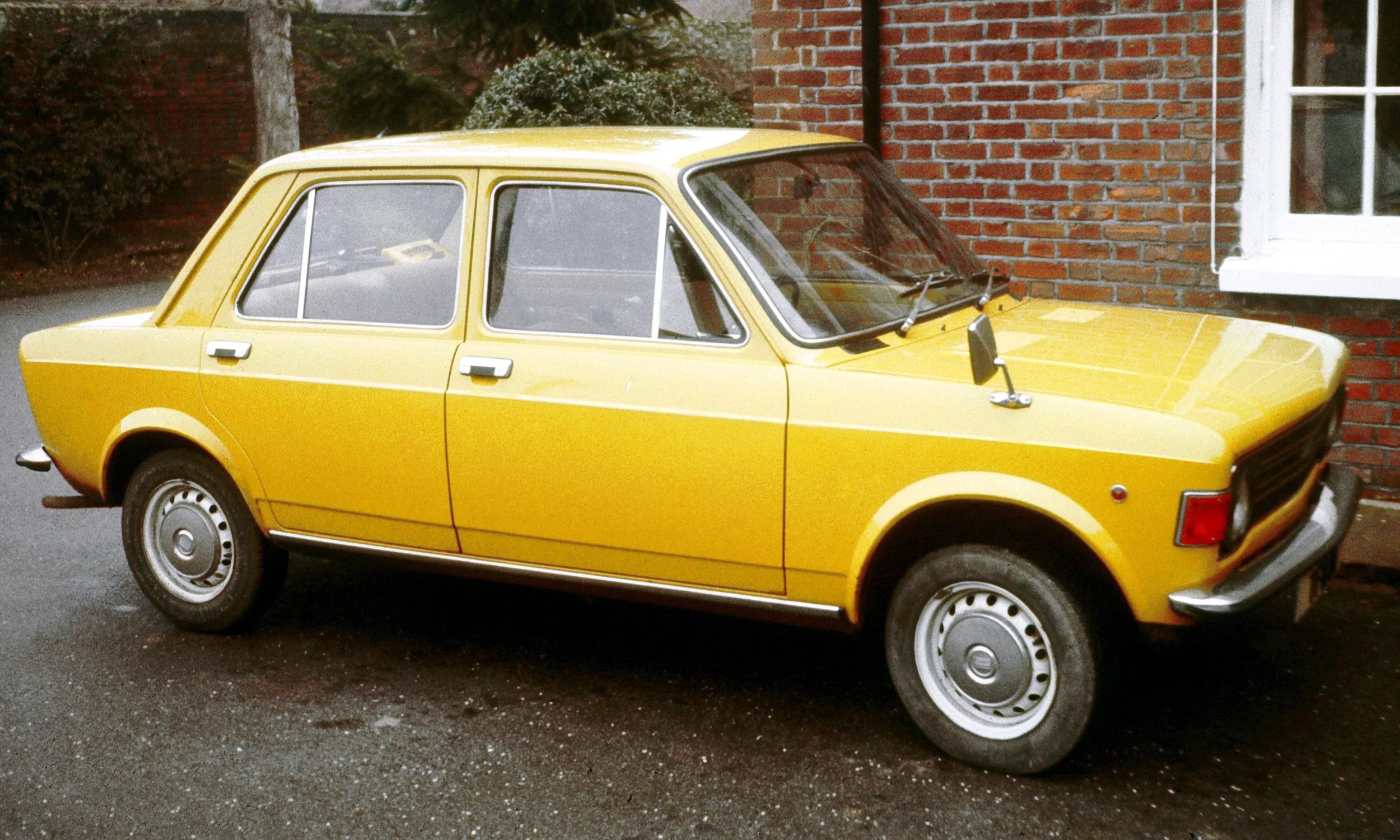
Flying down a shifting road in a car chase, Part Two, “The Historical Scene,” slingshots us into a panorama of 1970s political activism. Tasked with proliferating socialism and organizing rallies, the narrator moves through a series of deserted cities, picking up radicalized vagrants along the way. They all manage to fit inside one of the most peculiar and comical inventions of the novel: a self-propelling little yellow car that zips up, down, and around hairpin turns, never requires refueling, and possesses an absurdly spacious interior that seems to expand with every new passenger.
Abruptly spliced into their rallies are violent riots between “warriors,” equipped with wire cutters, and “feathered ones,” led by the baleful Black Nun. Like the rest of the novel’s bizarre occurrences, questions regarding these groups are left unanswered, forcing readers to reluctantly accept, immerse themselves, and press on.
Drawing upon his own experience within underground movements, Moresco accentuates his satirical depictions of political fanatics through a rogue, tattooed man who goes from town to town, swindling and seducing pairs of mothers and daughters. The narrator remarks on how difficult it would be to identify the assailant,“if only you knew how many hammers and sickles we’ve got going around... how many acronyms, how many nicknames…” and later at a shelter, an exchange highlights the frequent turnover and formlessness of these movements:
“in this diaspora of groups that break up, then immediately reunite under another name, with intentions that aren’t even the same anymore, they fight over the acronyms, the bit of money that remains to them, the weapons...”
Once his campaign ends, the Bald Man sends him to a neighboring city to connect with the rest of the political network, but he finds only an abandoned building upon arrival. The novel then quickly morphs into a spin-off of Kafka’s The Castle, featuring terse characters who emerge from thin air, tease with fragments of information, and withhold far more, leaving both the narrator and the reader befuddled by the hopeless predicament.
This atmosphere carries into Part Three, “The Party Scene,” where he is contacted by a publisher’s secretary about his manuscript but is thwarted time and again in his attempts to connect. After facing this circular exhaustion, the narrator begins to threaten the publisher, demanding that he abandon his pursuit and return the manuscript, in a gesture that echoes Bulgakov’s famous quip about the permanence of manuscripts. The publisher—revealed to be The Cat—mocks the vanity of writers and rejects the notion of taking the manuscript “back into the uncreated.”
Amid the chaos, a biographer from Ducale arrives at the narrator’s apartment, only to age rapidly, withering into a geriatric state within days before being hastily driven away by the delivery man from Part Two, who has converted his van into a hearse. This premature aging condition harks back to Turquoise’s son’s accelerated development in utero in Part One and becomes a hysterical aside to the narrator’s mounting perils.
The novel reaches its climax with an extravagant party attended by a host of iconic literary writers and characters, including Alexander Pushkin, Käthchen von Heilbronn, Smerdyakov, Emily Dickinson, Giacomo Leopardi, Blaise Pascal, and Miguel de Cervantes, among others. In its final scene, the narrator and The Cat appear on the roof, discussing the edifice he has written and the worlds he has created, before he demands to be struck down and delivers a third emphatic “Yes!”
Moresco’s style is unconventional, oblique, and, frankly, tedious at times. Metaphysical scenes unravel with ferocity and unwavering confidence, making it difficult to trace the threads slowly woven across the nearly 700-page novel. However, this quirk of his style stands in deliberate opposition to conventional narratives of absoluteness, definitiveness, and reflexivity. Moresco emulsifies the speciously real with the patently absurd in a manner that renders the two inextricable, forcing readers to accept rather than delineate. When reading The Beginnings, one is left with more clues, incomplete references, and missing pieces than there are slots to fill them. Notable motifs—an illustrious cat’s paw, conflagration, ladders—and recurring refrains are peppered throughout the work, alongside the persistent obscurity surrounding the two warring groups, leaving readers to wonder how (or if) Moresco connects these threads in the subsequent volumes of the trilogy.
Moresco’s manipulation of time and climate is another key feature of his vaporous narrative. Frequently, the narrator acknowledges instantaneous shifts not only in weather conditions but in entire seasonal transitions—from winter to summer and back again—all within mere minutes. Combined with numerous acts of sudden accelerate and decelerate, the novel becomes helter-skelter, both temporally and spatially. Beyond visual surrealism, Moresco also introduces auditory paradoxes, such as “They hit each other in absolute silence,” “I managed to speak without emitting any sound,” and cars skirting across windy roads in absolute silence, thereby materializing a metaphysical world akin to that of Cărtărescu’s Solenoid.
Set to be followed by equally dense English translations, Songs of Chaos (Canti del caos) and The Uncreated (Gli increati), Moresco’s episodic work constructs an anomalous canvas of ongoing invention, and, more importantly, leaves readers craving more. The narrator’s maturation, repetitious reinvention, and undisclosed response to The Cat pose a slew of angles to be explored. Credit is also due to Max Lawton, who has delivered yet another entrancing, uncompromising translation, ensuring the forthcoming volumes are in expert hands. The Beginnings is sure to frustrate, but those accustomed to the unnerving enigma of a Kafka or Krasznahorkai novel will quickly settle into this puzzling trilogy.
