The Anatomy of American Intervention
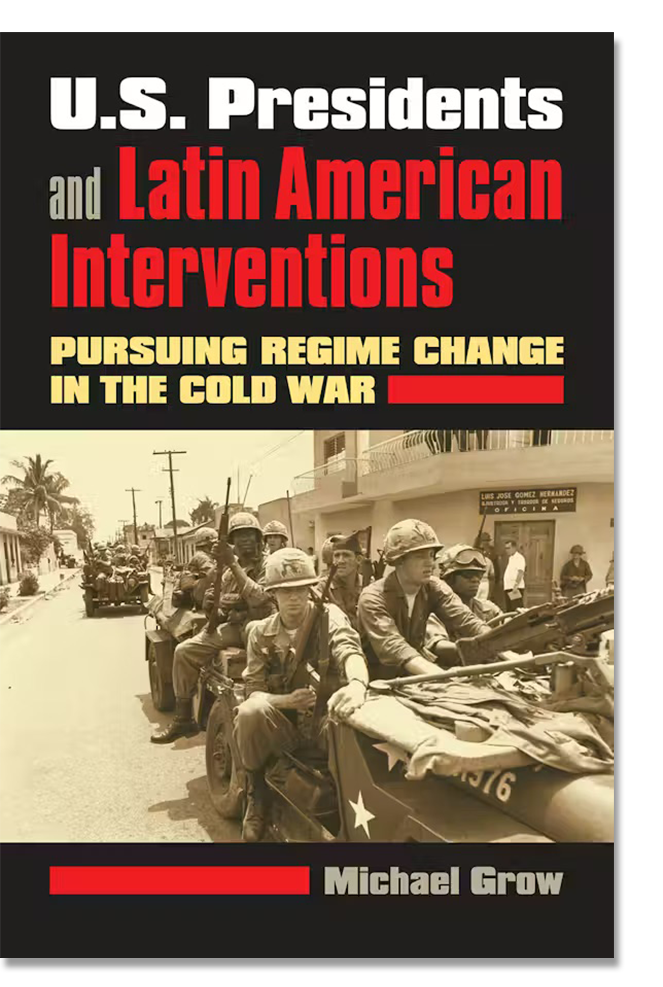
Reviewed:
U.S. Presidents and Latin American Interventions
by Michael Grow
University of Kansas Press, 280 pp., $29.99 (paperback)
Publication Date: 6/10/08
Eighty-four years have passed since the United States last declared war, though it’s a bit misleading to frame it that way. A formal declaration is a deliberately ambiguous term that obfuscates the slew of covert operations, convoluted interventions, and longstanding military conflicts the United States has engaged in since the end of World War II. Much to the chagrin of wounded veterans and protesting citizens, neither Korea, Vietnam, the Persian Gulf, Iraq, nor Afghanistan were congressionally approved wars, despite sharing all the vicious, generation-defining characteristics of one. So what accounts for the absence of congressional approval and the hasty willingness to intervene in foreign countries without any direct provocation or act of aggression?
In his historical analysis U.S. Presidents and Latin American Interventions, Michael Grow provides a revelatory framework for understanding the complexities of American interventions, not only in the past, but also in ongoing and imminent conflicts. Opening with President Eisenhower’s 1953 decision to green-light a CIA operation in Guatemala, Grow methodically walks readers through eight interlinked interventions in Latin America, concentrating on both the glaring and obscure factors that shaped U.S. foreign policy during the Cold War. Written in an accessible, roughly 200-page volume, his work offers an informative overview that highlights the idiosyncrasies of each conflict and how each unavoidably influenced the next.
In his farewell address in 1961, President Dwight D. Eisenhower warned against the emerging influence of the military-industrial complex, stating:
“In the councils of government, we must guard against the acquisition of unwarranted influence, whether sought or unsought, by the military-industrial complex. The potential for the disastrous rise of misplaced power exists and will persist.” - President Eisenhower, 1961
But what Eisenhower failed to warn us about were the underlying domestic and international pressures that have routinely led American presidents to take preemptive action. Grow alludes to these inconspicuous forces in his preface when he notes that economic and national security interests fail to tell the full story. He presents a five-prong view of influences on U.S. foreign policy, which can be outlined as: domestic political pressure, the preservation of international credibility, foreign political actors, economic interests, and national security. Each intervention encompassed a blend of these factors, setting a precedent and generating a ripple effect for how America would handle foreign opponents.
To fully grasp the decision-making process, one must consider the frenetic, tense climate of the Cold War. The close of World War II ushered in a new international order, with two global superpowers at the helm: the United States and the Soviet Union. With a heated rivalry underway, each country sought to secure hemispheric dominance and trigger favorable revolutions in neighboring nations, as if the political status of each were mere pieces on a checkerboard. In many Latin American countries that welcomed socialist revolutions, claims of a Soviet alliance or threats to U.S. security appeared weak at best. Yet Grow explains that the primary concern resided in the potential consequences of inaction:
“A weak or ineffectual U.S. response to that challenge, they believed, would encourage further Soviet adventurism and cause nervous U.S. allies to doubt the reliability of U.S. power, resulting in dangerous shifts in the global balance of power.” (p. 18)
Internally, the U.S. government believed and acted as if America’s international credibility and public image as the ‘leader of the Free World’ was always at risk. This concern was amplified and used as a formidable exigency after Cuba’s communist conversion under Fidel Castro and President Kennedy’s Bay of Pigs fiasco. The fear of another Cuba was repeatedly dangled before subsequent administrations as a cautionary tale of presidential weakness and incompetence. This “Cuban Syndrome” shaped CIA intelligence reports that grossly exaggerated Communist and Marxist influence within the Dominican Republic movement, while also pushing bellicose presidents to make good on their anti-communist campaign promises. Both Democratic and Republican presidents faced pressure from hawkish neoconservative opponents, as well as a public climate steeped in propaganda from the media, anti-regime factions within Latin America, and mega-corporations economically entrenched in the region. In each case, Grow carefully balances foreign provocations and official statements that made intervention seem favorable with the domestic pressures that pushed the final dominoes.
To round off his examination of U.S. interventions, Grow devotes nearly a quarter of his analysis to Bush’s 1989 invasion of Panama, explaining why the case stands as an outlier:
“The Panama invasion was a major departure from preceding U.S. interventions in the region in the sense that the target of U.S. hostility was not a Marxist leader or movement but a right-wing military officer who had worked closely with the United States for three decades.” (p. 160)
With the accelerating dissolution of the Soviet Union and the Communist threat, the Reagan administration found itself in firm control of the late–Cold War world, with clear intentions of shoring up U.S. hegemony. As Grow explains, the United States sought to establish a stable international system of “capitalist democracies, in which the United States, as the only remaining superpower, would utilize its overwhelming military superiority to guarantee global stability, working with cooperative allies and the United Nations to reduce international conflict, prevent aggression, and promote liberal models of national development” (p. 179) — or, in other words, to consolidate power in American hands.
In December 1989, newly elected President George H.W. Bush, formerly vice president under Reagan, seized the opportunity to deliver on his militant campaign promises by ending the dictatorship of Manuel Noriega in Panama and, in doing so, exemplify America’s resolve and legitimacy on the world stage. Despite the fact that Noriega was a rogue CIA-trained and funded ally turned foe, the invasion of Panama followed many of the same patterns as previous Latin American interventions. Bush, like every administration before him, operated under the presumption that he needed to prove his toughness and safeguard U.S. hegemony.
Insightful and brimming with nuance, Grow’s U.S. Presidents and Latin American Interventions is a refreshing, ever-relevant examination of the intricate rationale and pressures that drive American military action. Although tedious in its reporting and intentionally limited in scope, Grow provides readers with a predictive model for anticipating future U.S. responses to foreign opposition and incendiary conflicts. His incisive narrative is an invaluable resource for those seeking to look beyond propaganda and shallow political takes.
